
How to Start a Concrete Block Making Business in 2026: The Ultimate Guide
Start a profitable concrete block business. Our ultimate guide covers machine selection (manual vs. automatic), factory layout, mix ratios, and ROI.

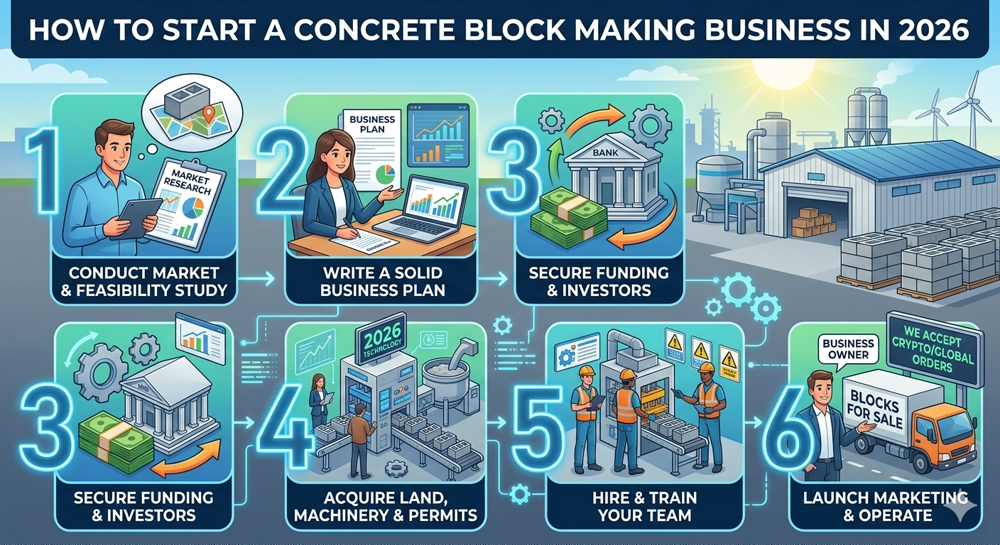
Starting a commercial concrete block manufacturing plant requires precise engineering calculations, careful machinery selection, and strict raw material control. Concrete block production is a high-volume, low-margin manufacturing process. Profitability depends entirely on optimizing cycle times, controlling raw material waste, and minimizing cement costs while meeting local structural strength standards.This guide provides a detailed operational blueprint, covering concrete mix design formulas, machine configurations, plant layout layout requirements, and factory-level cost modeling.
1. Concrete Mix Designs and Material CalculationsThe profitability of a block yard is determined by your mix design. Cement is your most expensive raw material. Your goal is to use the minimum amount of cement necessary to achieve the compressive strength required by local building codes, such as ASTM C90 (Loadbearing Concrete Masonry Units) in the US, which requires a minimum net area compressive strength of 13.1 MPa (1900 psi), or BS EN 771-3 in Europe.The Raw Materials
- Cement: Ordinary Portland Cement (OPC) Grade 42.5N or 52.5N. Do not use low-grade masonry cement (32.5R) for load-bearing block production, as it slows down demolding cycles.
- Fine Aggregate (0mm – 3mm): Sharp river sand or washed quarry dust. The sand must be free of clay and silt (silt content must be below 5%). Clay destroys cement bonding and causes blocks to crack during curing.
- Coarse Aggregate (3mm – 10mm): Crushed granite, pea gravel, or volcanic scoria. Coarse aggregate creates the structural backbone of the block, reducing the total surface area that needs to be coated by cement paste.
- Water: The water-cement (w/c) ratio for dry-cast concrete blocks is exceptionally low, typically between 0.28 and 0.35. The mix must be damp, not wet. When squeezed in your hand, it should form a ball without staining your palm with water or crumbling apart.
Standard Industrial Mix FormulasTo produce standard 8-inch hollow blocks (200mm x 200mm x 400mm) with a targeted compressive strength of 5 MPa to 7 MPa, factories utilize two primary mix designs depending on local raw material costs:Option A: Quarry Dust and Cement Mix (High Strength, Clean Finish)
- OPC Cement (Grade 42.5N): 50 kg (1 bag)
- Crushed Quarry Dust (0mm-5mm): 350 kg
- Water: 15 – 17 Liters
- Ratio: 1:7 by weight.
Option B: Three-Part Standard Industrial Aggregate Mix
- OPC Cement (Grade 42.5N): 50 kg (1 bag)
- Sharp River Sand: 200 kg
- Crushed Pea Gravel (3mm-8mm): 150 kg
- Water: 16 Liters
- Ratio: 1:4:3 by weight.
2. Machine Categorization, Hydraulic Pressures, and Output MetricsConcrete block machines use a combination of directional vertical vibration and hydraulic top-pressure to compact dry-cast concrete inside a mold steel box within seconds. Selecting the wrong machine configuration will ruin your operational budget.
[Raw Materials] -> [Twin-Shaft Mixer] -> [Skip Hoist / Conveyor] -> [Machine Hopper] -> [Mold Box Vibration + Hydraulic Press] -> [Wet Block on Pallet] -> [Automatic Stacker]
Type 1: Manual Egg-Layer/Mobile Machines
- Mechanism: These machines move along a concrete floor, dropping blocks behind them as they travel. They rely primarily on low-wattage eccentric vibrators (2.2 kW to 4 kW) with minimal hydraulic downward pressure.
- Hydraulic System Pressure: 0 to 5 MPa (Often gravity or manual lever-assisted).
- Pallet Requirements: None. Blocks are cast directly onto a massive concrete floor.
- Production Cycle Time: 45 – 60 seconds per drop.
- Daily Output (8-hour shift): 800 – 1,200 pieces of 8-inch blocks.
- Best Used For: Rural startups with large open concrete slabs and low labor costs.
Type 2: Stationary Semi-Automatic Hydraulic Plants
- Mechanism: The machine is anchored to a foundation. Raw materials are mixed in an elevated pan mixer and delivered via a conveyor belt to the machine hopper. Wet blocks are ejected onto wooden, PVC, or bamboo pallets.
- Hydraulic System Pressure: 12 MPa to 16 MPa.
- Vibration Frequency: 3,000 to 4,500 RPM (Driven by twin vibration shafts under the mold table).
- Production Cycle Time: 25 – 35 seconds per pallet (Typically 4 blocks of 8-inch per pallet).
- Daily Output (8-hour shift): 3,500 – 5,000 pieces of 8-inch blocks.
- Best Used For: Medium-scale commercial block yards entering municipal construction supply chains.
Type 3: Fully Automatic Multi-Layer Production Lines
- Mechanism: Controlled by an integrated PLC system (Siemens S7-1200 or Mitsubishi). Includes automated aggregate batching plants (PLD series), a twin-shaft forced mixer (JS500 or JS750), a face-mix system for color pavers, an automatic pallet feeder, and a block stacker.
- Hydraulic System Pressure: 16 MPa to 21 MPa (Utilizing proportional hydraulic valves to regulate speed and pressure precisely).
- Clamping Force / Top Pressure: Up to 100 kN.
- Production Cycle Time: 15 – 20 seconds per pallet (Multi-cavity molds: 8 to 12 blocks per drop).
- Daily Output (8-hour shift): 10,000 – 15,000 pieces of 8-inch blocks.
- Top Industrial Brands: Zenith (Germany), Hess Group (Germany), Tiger (Japan), Qunfeng (China), Santana (China).
3. Plant Footprint and Workflow LayoutA bottleneck in your material flow will destroy your daily production targets. A factory producing 4,000 blocks per day handles over 60 tons of raw materials daily. The factory layout must be linear or U-shaped to minimize loader travel distance.Land Area AllocationA semi-automatic plant requires a minimum of 1,500 to 2,500 square meters of level ground. A fully automatic plant requires 4,000+ square meters.The Core Operational Zones
- Aggregate Bins (20% of area): Three open-front structural three-sided brick bays to store sand, pea gravel, and quarry dust. Must be accessible by a wheel loader or tractor.
- Mixing and Batching Platform (10% of area): The cement storage silo or bag warehouse must sit directly next to the mixer. The mixer must be elevated so it can discharge directly onto the conveyor belt leading to the block machine.
- Production Workshop (15% of area): A covered, concrete-floored building protecting the main hydraulic block machine, electronic control panel, and hydraulic power unit from dust and rain.
- Wet Block Curing Zone (25% of area):
- Natural Curing: Blocks stay on pallets for 24 hours in a draft-free room to prevent rapid evaporation. Then, they are moved to the outdoor curing yard where they must be kept continuously wet via misting nozzles or manual hose spraying for 7 days.
- Steam Curing (Advanced Factories): Blocks enter insulated kilns at 60°C with 95% humidity for 12 hours. This accelerates cement hydration, allowing blocks to reach 70% of their structural strength overnight, clearing out your pallet inventory immediately.
- Finished Stockyard (30% of area): Cured blocks are stacked 4 to 5 layers high on heavy-duty pallets, ready for forklift loading onto flatbed delivery trucks.
4. Full Financial Modeling and Cost AnalysisTo understand the business unit economics, we will model a mid-sized factory utilizing a Semi-Automatic Hydraulic Block Machine (Mold configuration: 4 pieces of 8-inch hollow blocks per cycle) operating in an emerging market or industrial zone.Initial Capital Expenditure (CapEx)
| Item Description | Specifications / Details | Estimated Cost (USD) |
|---|---|---|
| Main Block Machine & Mixer | QT4-24 or QT4-15 semi-automatic line with conveyor | $14,000 |
| Production Pallets | 1,500 pieces (High-density PVC or GMT pallets) | $4,500 |
| Mold Boxes | 1x 8-inch Hollow, 1x 6-inch Hollow, 1x Interlocking Paver | $2,500 |
| Site Preparation & Shed | Reinforced concrete foundation for machine + steel roof shed | $6,000 |
| Electrical Installation | 3-Phase Industrial Power Connection (30kW min capacity) | $3,000 |
| Logistics Equipment | Used 2.5-ton diesel forklift or manual hydraulic pallet jacks | $5,000 |
| Total CapEx Investment | $35,000 |
Operational Variables and Production Costs (Per 8-Inch Block)Assumptions: Standard 8-inch hollow block weight is 16 kg. Mix design is 1 bag of cement (50kg) to 350kg of quarry dust, yielding exactly 25 blocks per bag of cement.
- Cement Cost: $8.50 per 50kg bag \(\rightarrow \) $0.34 per block
- Quarry Dust/Sand Cost: $15.00 per ton (1,000 kg) \(\rightarrow \) 14 kg required \(\rightarrow \) $0.21 per block
- Water & Power Consumption: $0.02 per block (Based on industrial power rates and pump usage)
- Labor Cost: 6 factory workers at $20/day ($120 total) producing 3,200 blocks daily \(\rightarrow \) $0.038 per block
- Wear, Maintenance, and Mold Depreciation: Allocation of $0.012 per block
Total Manufacturing Cost (Excluding land lease): $0.62 per blockRevenue, Margins, and Payback Period
- Average Wholesale Market Price (8-inch block): $0.85 per piece.
- Net Profit Margin per Block: \(\$0.85 - \$0.62 = \mathbf{\$0.23}\) profit per block.
- Daily Net Profit (at 3,200 blocks/day output): \(3,200 \times \$0.23 = \mathbf{\$736.00}\) per day.
- Monthly Net Profit (24 working days): \(24 \times \$736 = \mathbf{\$17,664.00}\).
Estimated Machine Payback Period: Under optimal operational efficiency and consistent local market demand, the initial CapEx investment of $35,000 can be fully recovered within 2 to 3 months of continuous manufacturing operation.
Block Machine Categorization & Performance Metrics
| Machine Type | Hydraulic Pressure | Vibration Frequency | Production Cycle Time | Daily Output (8-Hr Shift) |
|---|---|---|---|---|
| Manual Mobile (Egg-Layer) | 0 - 5 MPa | 1,500 - 2,500 RPM | 45 – 60 seconds | 800 – 1,200 blocks |
| Semi-Automatic Stationary | 12 - 16 MPa | 3,000 - 4,500 RPM | 25 – 35 seconds | 3,500 – 5,000 blocks |
| Fully Automatic Production Line | 16 - 21 MPa | 4,500+ RPM | 15 – 20 seconds | 10,000 – 15,000 blocks |
5. Machine Procurement and Quality ChecklistWhen sourcing concrete block machinery directly from industrial manufacturers in China or Europe, do not buy based on the price tag alone. Verify the following mechanical and structural specifications before signing a purchasing contract:
- Carburizing Heat Treatment on Molds: Standard steel molds wear out within 30,000 cycles due to abrasive sand friction. Ensure the manufacturer uses line-cutting steel fabrication with carburizing heat treatment. This extends the lifespan of the mold box to over 100,000 production cycles.
- Vibration Table Construction: The vibration table must be cast iron or heavy structural steel plate, not welded sheet metal. Ask if the vibrators use integrated synchronous shafts or separate external motors. Synchronous shafts ensure uniform block density across the entire pallet.
- Hydraulic Cylinder Seals: Low-grade cylinders leak hydraulic fluid within months when exposed to abrasive cement dust. Demand Japanese NOK brand hydraulic oil seals in the cylinder specifications sheet.
- GMT vs. Wooden Pallets: Traditional wooden pallets warp and rot under continuous water-spraying curing conditions, causing blocks to bend. Choose GMT (Glass Mat Reinforced Thermoplastic) pallets. They are waterproof, resistant to chemical corrosion, and have a structural lifespan exceeding 5 years.
6. Sourcing Direct Factory Quotations Selecting the exact machinery configuration that matches your budget and local aggregate type requires direct technical consulting with factory engineers.If you are currently setting up a concrete block manufacturing facility and require direct-from-factory pricing and technical configuration documents, you can contact our heavy machinery logistics network.We assist commercial buyers in sourcing certified, high-pressure concrete block production lines with custom mold fabrication.
Request Technical Blueprints & Factory Quotes
Submit your machinery parameters below. Connect directly with verified, certified heavy industrial manufacturers to receive custom foundation drawings, layout schematics, and direct-from-factory pricing.